sportal
A live football tracker that also runs the TV wall.
The problem
On a football Saturday there are more good games than screens. I wanted one tool that knows the state of every game right now, and that can arrange the games I’m watching across a desk, a TV and a phone, all agreeing on what’s happening.
What I built
sportal is a pnpm monorepo with three apps:
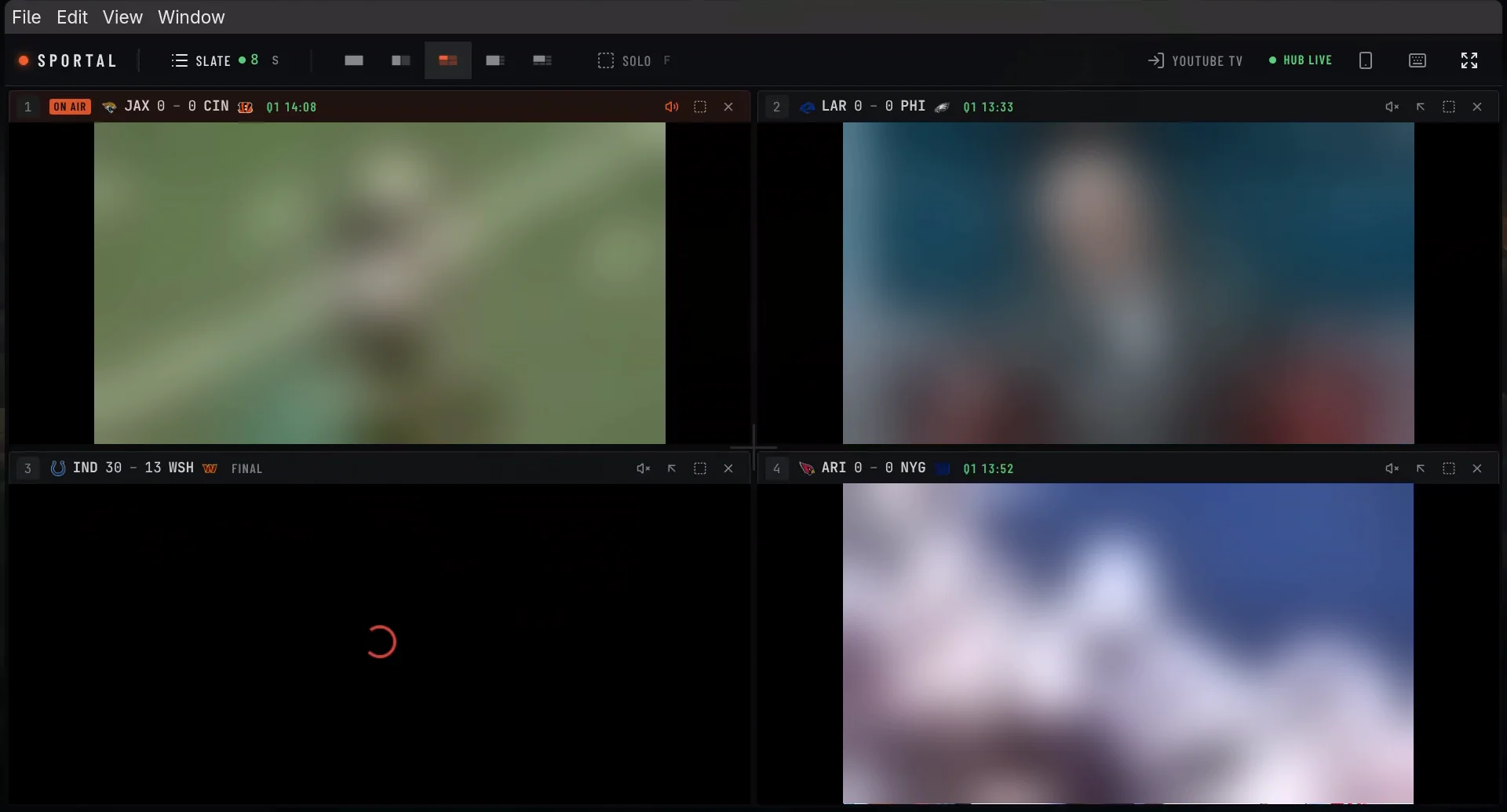
- The Hub is one server process. It polls ESPN’s scoreboard for the day’s games, takes live updates from ESPN’s push feed, folds them into one in-memory slate of games, and serves it to clients over a single WebSocket, as requests and live queries.
- The web app is a React tracker that works in any browser: scores, game situations (down and distance, field position), play-by-play, team stats and win probability.
- The desktop shell is an Electron app whose tiles are the streaming providers’ own web players. sportal only positions, tunes and mutes them. It never touches the video, so DRM is left alone.
Key decisions
-
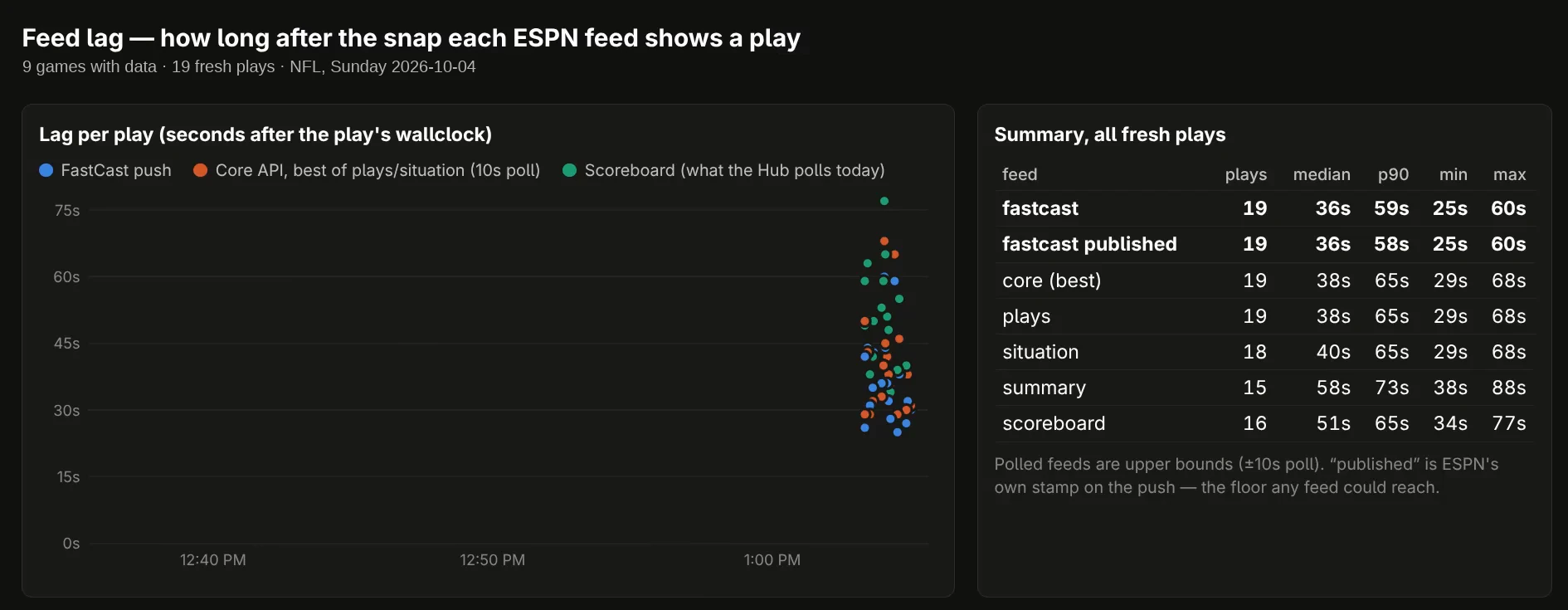
Measure before choosing a feed. ESPN has several feeds, and none documents its lag. I recorded them side by side through an NFL Sunday window and timed each play from the snap to when each feed first showed it. FastCast, ESPN’s push feed, was fastest: a median of 28 s over 382 plays, against 41 s for the scoreboard the Hub had been polling. So FastCast became the live source, and the scoreboard poll still lists the day’s games.
-
Feeds are untrusted. The score feeds are unofficial and can change shape without notice. Everything entering through the provider boundary is decoded against a schema on the way in.
-
One definition per concept. Each domain concept is declared once, as an Effect Schema. That one declaration is its type, its decoder and its wire format.
-
Updates can arrive out of order. The slate is a pure function from the current state plus a delivery to the next state, and it orders snapshots by game time, so a stale update can never move a game backwards. The pure core is tested directly.
-
Time is injected. All time comes from Effect’s clock, so tests replay a recorded game at any speed. The same mechanism gives each TV tile a spoiler delay that holds back scores to match its stream.
-
The structure is checked. Dependency rules and dead-code checks run in CI next to the tests, so the architecture can’t quietly erode.
What I’d do next
- Keep the slate between Hub restarts.
- Run the Hub in the cloud as well as at home, which the design already allows.